
Beyond Trial and Error: How Generative AI is Redefining Structural Optimization
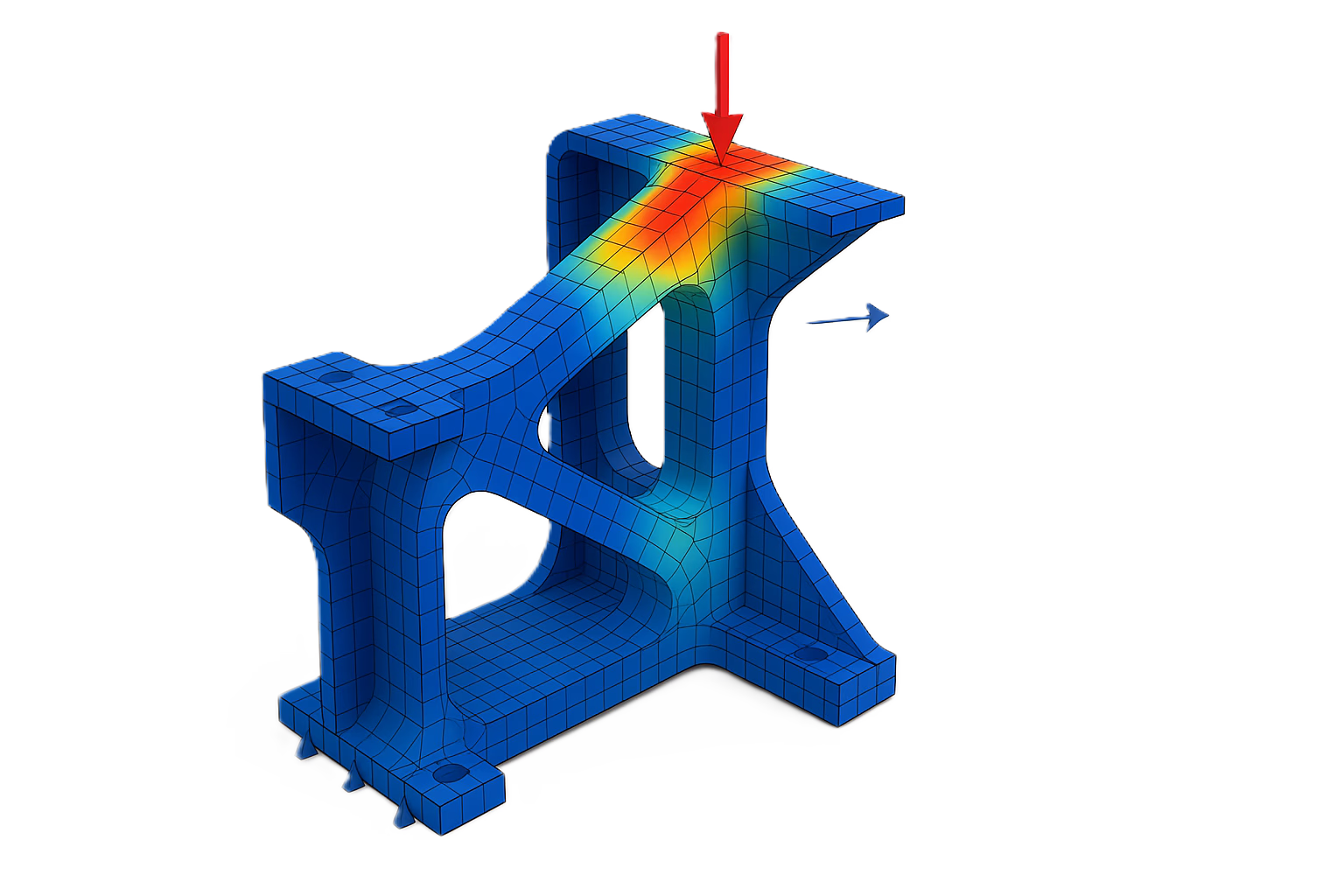
For decades, the relationship between design engineering and Finite Element Analysis (FEA) has been linear and reactive. A designer creates a CAD model based on intuition, experience, and legacy data. They hand it to the FE analyst, who acts as a gatekeeper: meshing the part, applying loads, and running the solver. The result is a binary output: “pass” or “fail.”
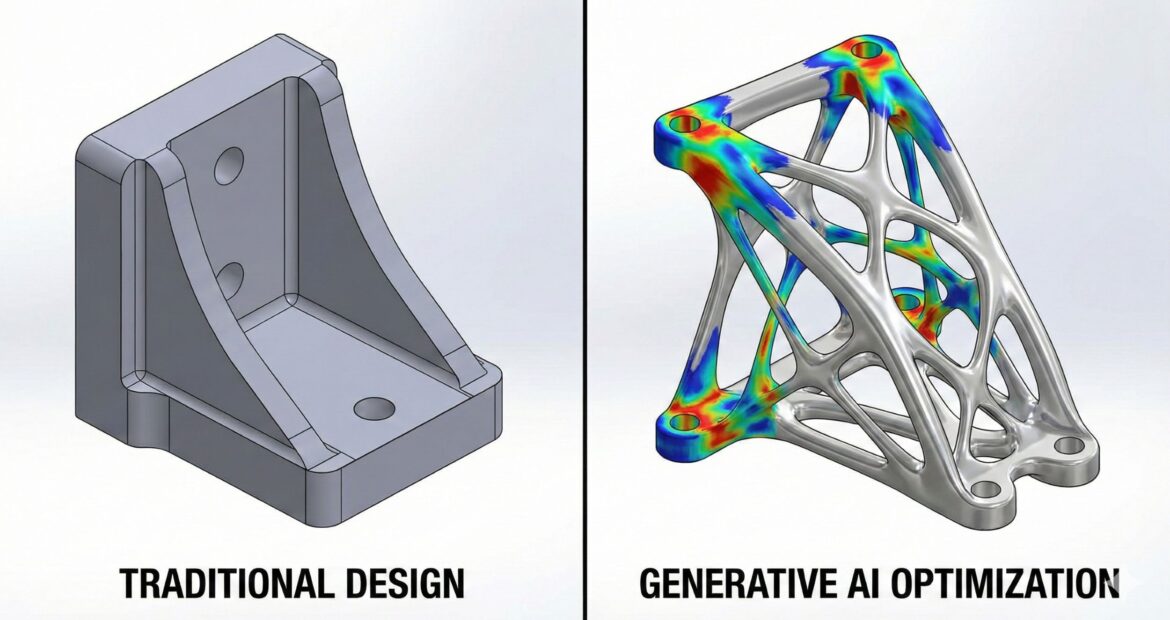
If the design fails, it loops back to the drawing board, burning valuable engineering hours. If it passes, it is often celebrated, yet the reality is usually less ideal. A “passing” design is frequently over-engineered, heavier, costlier, and more material-intensive than necessary, simply because the human mind naturally gravitates towards safe, blocky, prismatic shapes that are easy to visualize.
This “guess and check” loop is the primary bottleneck in modern engineering cycles. It limits innovation to what a human can conceive and restricts optimization to minor tweaks of an already suboptimal geometry.
But we are witnessing a paradigm shift. What if we inverted this process? What if, instead of drawing the geometry first, we defined the problem first, the loads, materials, and constraints, and let an algorithm generate the optimal geometry?
This is the promise of Generative AI in structural engineering. It is not about replacing the FE engineer; it is about empowering them with the most significant leap in capability since the invention of the finite element method itself.
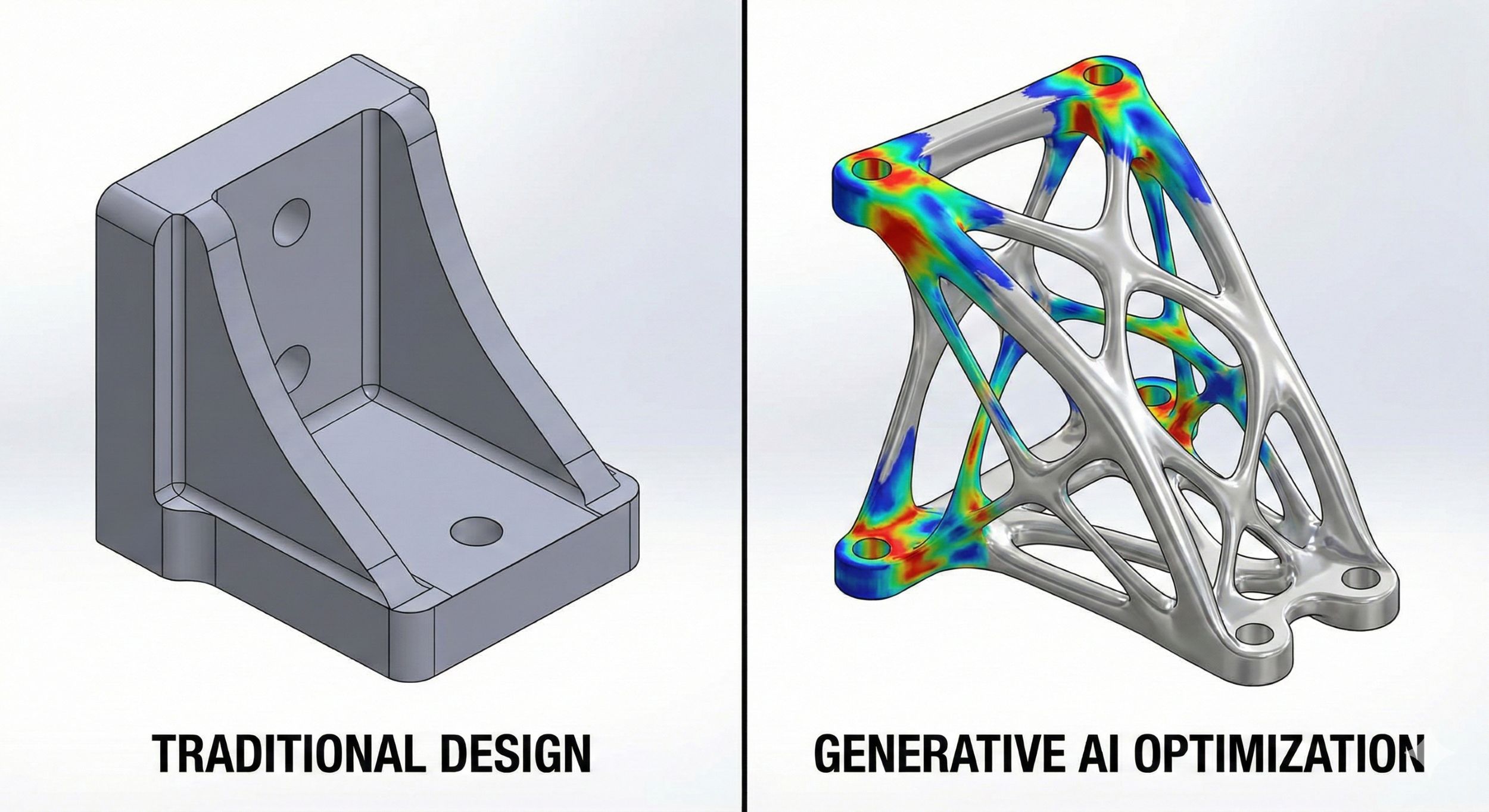
The Paradigm Shift: From Validation to Exploration
To understand the magnitude of this shift, we must first distinguish between two terms often used interchangeably: Topology Optimization and Generative Design.
Topology Optimization: The Refiner
Topology optimization has been around for years. It takes an existing design with a defined volume and mathematically removes material that isn’t carrying a load. Think of it as carving a statue from a specific block of marble. You are limited by the size and shape of the original block. It creates a lighter version of what you already have, but it doesn’t invent anything new.
Generative Design: The Creator
Generative Design, powered by AI, is fundamentally different. It doesn’t start with a block; it starts with nothing but the “design space” (the void where a part could exist). Using cloud-computing power, it explores thousands of potential permutations simultaneously. It tests different material types and manufacturing methods in parallel.
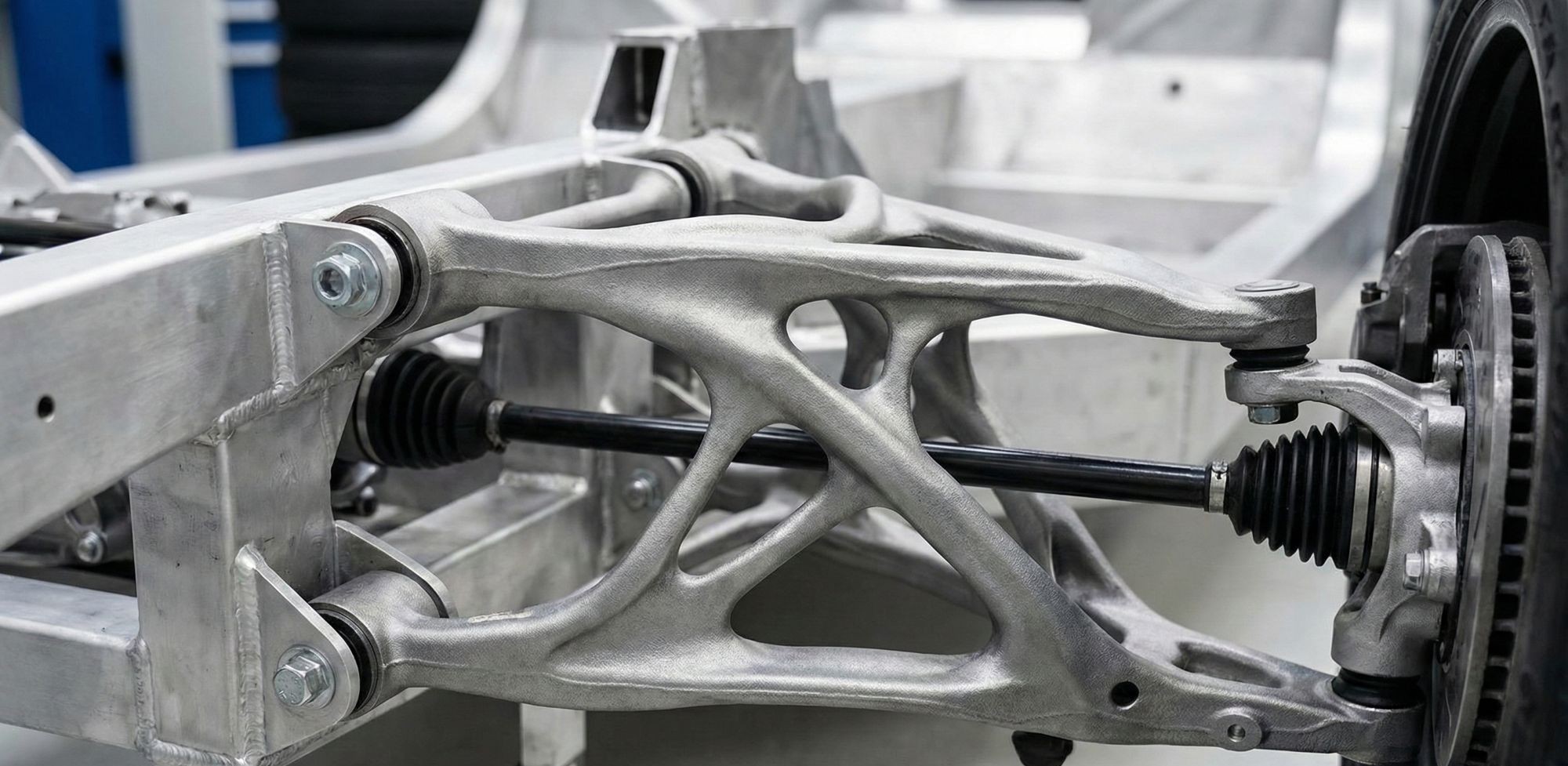
It doesn’t just refine; it explores. It might suggest a shape that no human engineer would ever draw, an organic, bone-like structure that perfectly aligns material with the stress paths.
Flipping the Workflow: Defining the “Why” Before the “What”
In a traditional workflow, FEA is a validation step at the end of the chain. In an AI-driven workflow, FEA principles are embedded at the very beginning. This requires the FE engineer to evolve. You are no longer just checking homework; you are setting the exam questions.
The engineer must define the Boundary Conditions with extreme precision. The AI is a literalist, it will give you exactly what you ask for, which is not always what you want.
1. The Design Space & Keep-Out Zones
The engineer defines the volumetric limits. Where must material exist (bolt holes, bearing surfaces)? Where cannot material exist (clearance for a moving piston, assembly paths)?
2. Loading Conditions: The “Real World” Input
This is where the FEA expert shines. A generic designer might apply a static load. An FE expert knows that dynamic loads, vibrational frequencies, and thermal expansion are the real killers. By inputting complex multi-physics load cases upfront, the AI evolves a structure that is robust against real-world failure modes, not just static weight.
3. Manufacturing Constraints: The Critical Link
This is the most significant recent advancement. Early generative algorithms produced “alien” shapes that were mathematically perfect but impossible to manufacture.
Modern AI solvers now accept Manufacturing Constraints as a primary input. You tell the system:
- “I am using a 3-axis CNC mill with a 5mm tool.” (The AI avoids undercuts).
- “I am Die Casting this part.” (The AI enforces draft angles and split lines).
- “I am using Additive Manufacturing (3D Printing).” (The AI minimizes overhangs that would require support structures).
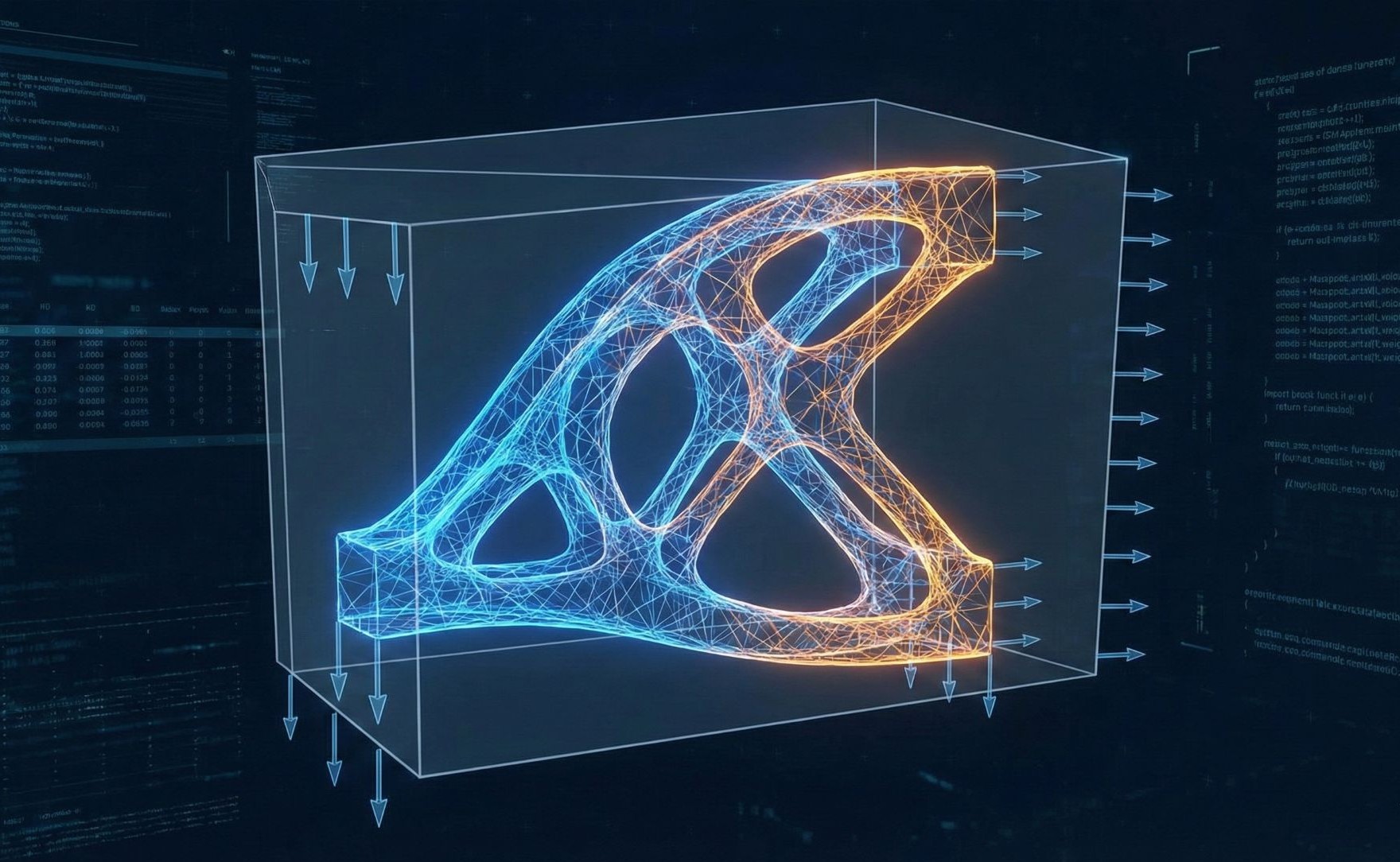
The New Role of the FE Engineer: Analyst to Architect
A common fear among engineering professionals is that AI will automate their jobs away. In the context of MSTECH and high-level structural analysis, the opposite is true. AI automates the tedious calculations, but it elevates the importance of engineering judgment. Generative design tools obey the principle of “Garbage In, Garbage Out.” If the load cases are simplified or the material fatigue limits are misunderstood, the AI will confidently generate a perfectly optimized part that fails catastrophically in the field. The role of the MSTECH engineer shifts from “Mesh Fixer” to Simulation Architect:- Problem Definition: Translating complex physical requirements into mathematical constraints the AI can understand.
- Candidate Selection: The AI might return 100 valid solutions. One minimizes mass, another minimizes deflection, and a third minimizes cost. The engineer must interpret these trade-offs.
- Verification: This is non-negotiable. AI models are approximate. Once a generative design is selected, it must be exported and subjected to a rigorous, traditional FEA validation using industry-standard solvers (like Ansys, Nastran, or Abaqus). The FE engineer is the final sign-off authority.
The “Black Box” Problem: Trusting the Algorithm
One of the biggest hurdles for traditional engineers is the “Black Box” nature of AI. “How do I know this web-like structure is safe? I can’t calculate the stress on a napkin anymore.” This skepticism is healthy. We address this through Convergent Modeling. In the past, converting a generative “mesh” back into a usable CAD solid (B-rep) for validation was a nightmare of broken geometry. Modern tools now allow for seamless export of the optimization mesh into validation software. At MSTECH, we don’t just “trust” the AI. We run a non-linear verification pass. We test the AI-generated geometry against buckling loads and fatigue cycles that the generative algorithm may not have fully accounted for. We often find that while the AI is excellent at placing material for stiffness, the human engineer is still needed to optimize for durability and fracture toughness. The collaboration is symbiotic: AI provides the topology; the engineer ensures the integrity.Real-World Impact: Lightweighting & Sustainability
The most immediate application of this technology is Lightweighting, but the implications go beyond just “shaving grams.” In the automotive and aerospace sectors, mass reduction is directly tied to energy efficiency. For Electric Vehicles (EVs), every kilogram removed from the chassis or suspension translates to extended range. Generative design projects routinely achieve mass reductions of 30% to 50% while maintaining structural stiffness. But there is also a massive Part Consolidation benefit. Imagine a bracket assembly that currently consists of 4 welded sheet metal parts, 6 bolts, and 6 washers. That is 16 items on your Bill of Materials (BOM), 16 failure points, and significant assembly time. Generative AI can grow this as a single monolithic part.- Inventory cost: Down.
- Assembly time: Zero.
- Weak points: Eliminated.